
Loulie H. Sutro
Class of 2026
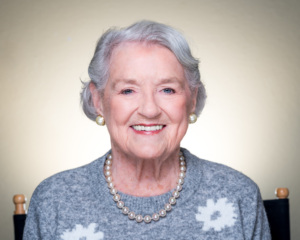
Mother, widow, and community leader, Loulie Hyde Sutro, was born in Hartford, Connecticut on July 2, 1935. As a child, she constantly watched her father, a financial adviser and nationally ranked tennis player, leave for work early in the morning and return home late at night. Her mother, on the other hand, was always present and caring for Loulie and her younger brother– except, of course, for when she was volunteering to work with at-risk children. Her mother’s dedication both to her family and community service instilled Loulie with the love of serving others from a very young age.
As she grew older, Loulie attended a small, all-girls liberal arts high school where she found community with her classmates and thus felt a whole new world opening to her. Her senior year culminated in her election to student government as president of the Service Club, where she became deeply involved with hospitals and community centers for underprivileged children. Loulie’s service persisted through College in New England, where, as a Sociology major, she made weekly visits to at-risk children from lower income communities.
Following college in the late ‘50s, Loulie took a human resources position in a large Hartford insurance company. Here, she created and wrote an employee manual that they adapted. This experience honed her public speaking skills as she explained the functions of the human resources department to new trainees. In fact, during a time in which female interviewers were only allowed to interview other women, she interviewed nearly 30 prospective female employees every day!
Despite nearly four years of progressive strides in the HR position, Loulie realized her life in Hartford was much too narrow and she was beginning to grow bored. So, at age 26, she ignored her parents’ objections and made one of the most significant decisions in her life: she moved to San Francisco. Upon arrival, Loulie answered a newspaper ad and started as a consultant in the Red Cross Youth Division of the Bay Area Chapter of the American National Red Cross.
It’s here that, for four years, Loulie devoted herself to teaching community service, leadership, and international understanding to impressionable students who carried those lessons back to their homes and schools. She worked tirelessly across the city, and as Curriculum Director, led an intensive leadership development camp for top high school students. The organization quickly came to rely on her to support troubled youth, solve complex problems, and help expand its increasingly successful programs. Her leadership potential was unmistakable.
This transformative experience was made possible by two charismatic former teachers who served as her mentors and supervisors. Under their guidance, Loulie discovered that this role taught her more about herself than her four years of college ever had. She uncovered strengths, confidence, and insight that would shape her future successes.
At the Red Cross, Loulie also discovered her creative voice– designing a monthly newsletter, developing learning activities, and consulting on leadership and service projects that students carried back to their own schools. Through her mentorship, they didn’t just learn leadership; they lived it. She spoke at high school assemblies, taught at leadership camps, and was regularly trusted to solve problems independently– an autonomy she embraced and thrived in.
She worked harder and longer than ever before, often handling difficult situations with adults and teens alike, staying late to complete projects without ever resenting the hours. In doing so, Loulie realized she was capable of far more than she had imagined and felt deeply proud and fulfilled by her work.
At 31 years of age, Loulie left her career at the Red Cross to marry her husband, attorney and judge John A. Sutro, Jr., and start a family. The years grew into decades and her three children– who became her absolute priority– grew to be successful young adults.
Though her family became her main priority, Loulie did not sit still. She continued to serve on at least a dozen non-profit boards, often as president, or on the executive committee. She also studied at San Francisco State University for her masters degree in creative writing. Her poems were published in Western journals, and she rewrote an outmoded best-selling book, Checklist for a Perfect Wedding, which is still in print. She also picked up hobbies such as group singing, tennis, traveling with family, and entertaining her friends.
Loulie’s life changed yet again when she served on the 2006–2007 Marin County Civil Grand Jury, a watchdog body overseeing county government and advising the Board of Supervisors. During her tenure, she authored a report on conservation and contributed to another examining the growing senior population in Marin County. Through visits to community agencies serving older adults, she came face-to-face with the challenges ahead—particularly the reality that the County lacked the capacity to fully address many of the urgent issues identified.
Toward the end of her term on the grand jury, Loulie learned of an innovative volunteer nonprofit called Beacon Hill Village in Boston, Massachusetts. They provided physical and emotional assistance to seniors in the area who wanted to continue living in their own homes. Their model, designed chiefly to address the needs of the forgotten middle class who were not eligible for government assistance, included a wide variety of volunteer opportunities from errands, rides to appointments, dog walking, garden care, and everything short of medical assistance. Most importantly, social activities were included, giving senior citizens opportunities to socialize that they would not have received otherwise. On her own, Loulie joined other attendees in 2007 at a sold-out, three-day seminar in Boston to learn about groundbreaking work of Beacon Hill Village and the best practices for starting a village of their own.
This eventually grew into a massive movement with over 300 villages across the country. Inspired, Loulie returned home and immediately gathered the smartest, most like-minded people she knew–along with several colleagues from the Grand Jury–around a lunch table to imagine how the model could take root locally. In 2008, that conversation became action when she founded Marin Villages, the first of what would grow into more than 50 villages across California. Today, Marin Villages serves over 550 members, is supported by more than 500 volunteers, and operates with a dedicated staff and centrally located office.
Loulie did not merely start Marin Villages; she thoughtfully adapted the model to fit Marin County’s unique structure. She pioneered a “hub-and-spoke” system– one centralized headquarters serving Marin County, with geographically based villages operating as integrated extensions rather than independent entities. This approach eliminated the substantial administrative costs that would have arisen had each village functioned on its own, while allowing communities to share volunteers, donors, and programs. The effectiveness of this model has since inspired its adoption by villages across the country.
Loulie guided Marin Villages as founder and board chair from its inception through 2016 and continued her leadership as steering committee chair of Ross Valley Village for five years after retiring from the Marin Villages board. Today, she serves on the Advisory Council, continuing to offer insight and guidance as a proud President Emerita.
Remarkably, Loulie began the work of creating Marin Villages at the age of 73. Now 90, she remains an active participant in local village activities, fully benefiting from– and embodying– the organization she created and its mission to help seniors live well at home.
At Marin Villages’ recent 15-year celebration, former U.S. Surgeon General Vivek Murthy spoke about the organization’s profound impact, highlighting how Loulie’s vision has helped prevent social disconnection and loneliness while improving health outcomes for thousands of older adults.
Loulie’s fellow founders and longtime friends remain closely connected to Marin Villages, contributing not only to its continued success, but also to the enduring strength of the idea and the care with which Loulie brought it to life. As she once said, “No one asked me to do this, but I knew something had to be done, and I was determined to try.”
Now in her tenth decade, Loulie hopes her life’s work has inspired others–not only to become involved with Marin Villages, but to engage more deeply in their own communities as well.